HP TGT COMMISSION MOCK TEST Dec-2025
| Part-01 | Subjective |
| Part-02 | General Subject |
Advanced Biology & Zoology Question Bank
Level: Class 11 to B.Sc. (Hard/Competitive) Total Questions: 80 (40 Biology/Botany + 40 Zoology)
Part 1: Biology (Botany, Cell Biology, Genetics, Molecular Biology)
1. In C4 plants, the primary carboxylation reaction occurs in the ______ and is catalyzed by ______. A. Bundle sheath cells; RuBisCO B. Mesophyll cells; PEP Carboxylase C. Mesophyll cells; RuBisCO D. Bundle sheath cells; PEP Carboxylase
2. Which of the following best describes the “Wobble Hypothesis” regarding codon-anticodon pairing? A. The 1st base of the codon pairs loosely with the 3rd base of the anticodon. B. The 3rd base of the codon pairs loosely with the 1st base of the anticodon. C. Specificity is determined solely by the ribosome structure. D. A single tRNA can recognize only one specific codon.
3. During the cell cycle, the transition from G2 to M phase is regulated by the activation of: A. p53 and Rb protein B. Cyclin D-CDK4 complex C. Cyclin B-CDK1 complex (MPF) D. APC/C (Anaphase Promoting Complex)
4. In the Electron Transport Chain (ETS), which complex does NOT pump protons across the inner mitochondrial membrane? A. Complex I (NADH dehydrogenase) B. Complex II (Succinate dehydrogenase) C. Complex III (Cytochrome bc1) D. Complex IV (Cytochrome c oxidase)
5. Which form of DNA is a left-handed helix with 12 base pairs per turn? A. A-DNA B. B-DNA C. Z-DNA D. C-DNA
6. A plant genotype AaBbCc is self-crossed. Assuming independent assortment, what proportion of the progeny will be homozygous for all three traits (aabbcc, AABBCC, etc.)? A. 1/64 B. 1/8 C. 1/16 D. 1/32
7. Photorespiration involves the movement of metabolites between which three organelles in sequence? A. Chloroplast → Mitochondria → Peroxisome B. Chloroplast → Peroxisome → Mitochondria C. Mitochondria → Chloroplast → Peroxisome D. Peroxisome → Chloroplast → Mitochondria
8. The casparian strip in the plant endodermis is primarily composed of: A. Cutin B. Suberin C. Lignin D. Pectin
9. In genetic mapping, if the interference value is 1.0, it indicates: A. Complete positive interference (No double crossovers observed). B. Complete negative interference. C. High frequency of double crossovers. D. Independent assortment is occurring.
10. Which of the following is an inhibitor of the enzyme Enolase in the glycolysis pathway? A. Arsenate B. Iodoacetate C. Fluoride D. Cyanide
11. The “Quiescent Center” in a root apical meristem represents: A. Cells with high mitotic activity. B. Cells that differentiate into vascular tissue. C. A reservoir of cells with low mitotic activity to replace damaged meristematic cells. D. The region of rapid elongation.
12. In the lac operon, the presence of glucose results in: A. High cAMP levels and high transcription. B. Low cAMP levels and low transcription (Catabolite Repression). C. Binding of the repressor to the operator. D. Constitutive expression of the operon.
13. Which class of algae reserves food as Floridean starch? A. Chlorophyceae B. Phaeophyceae C. Rhodophyceae D. Xanthophyceae
14. The conversion of atmospheric nitrogen to ammonia by nitrogenase requires: A. 8 ATP and 4 electrons per NH3. B. 16 ATP and 8 electrons per N2 molecule fixed. C. No ATP, only reducing power. D. Oxygen as an electron acceptor.
15. Transposons that move via an RNA intermediate are known as: A. Class II elements B. Retrotransposons C. Ac-Ds elements D. IS elements
16. Which plant hormone is derived from the isoprenoid pathway and promotes seed dormancy? A. Gibberellin B. Auxin C. Cytokinin D. Abscisic Acid (ABA)
17. The geological era known as the “Age of Gymnosperms” is: A. Cenozoic B. Mesozoic C. Paleozoic D. Precambrian
18. In protein synthesis, the enzyme Peptidyl Transferase is a component of: A. The small ribosomal subunit (30S/40S) B. The large ribosomal subunit (50S/60S) – specifically rRNA C. The tRNA molecule D. The mRNA cap
19. Which interaction explains the 9:7 phenotypic ratio in F2 generation? A. Dominant Epistasis B. Recessive Epistasis C. Complementary Gene Action D. Supplementary Gene Action
20. Water potential ($\Psi_w$) is mathematically described as: A. $\Psi_s + \Psi_p$ B. $\Psi_s – \Psi_p$ C. $\Psi_p + \Psi_m$ D. $\Psi_s \times \Psi_p$
21. T-DNA, used for gene transfer in plants, is found naturally in: A. Bacillus thuringiensis B. Agrobacterium tumefaciens C. Escherichia coli D. Thermus aquaticus
22. During meiosis, the Synaptonemal Complex dissolves during: A. Zygotene B. Pachytene C. Diplotene D. Diakinesis
23. The theoretical ATP yield from the complete oxidation of one molecule of glucose in eukaryotes (using the Malate-Aspartate shuttle) is: A. 30 ATP B. 32 ATP C. 36 ATP D. 38 ATP
24. Which fungal group is known as “Fungi Imperfecti” (Deuteromycetes)? A. Those that lack sexual reproduction. B. Those that lack asexual reproduction. C. Those that are coenocytic. D. Those that form basidiospores.
25. A plant with Kranz anatomy is likely to have which physiological characteristic? A. High photorespiration rate. B. Low water use efficiency. C. High CO2 compensation point. D. Low CO2 compensation point.
26. Which blotting technique is used for the detection of specific RNA sequences? A. Southern Blot B. Northern Blot C. Western Blot D. Eastern Blot
27. The function of the spliceosome is to: A. Join Okazaki fragments. B. Remove introns from pre-mRNA. C. Add a Poly-A tail. D. Degrade defective proteins.
28. Guttation in plants occurs through specialized pores called: A. Stomata B. Lenticels C. Hydathodes D. Pneumatophores
29. In ecological succession, the “climax community” is best characterized by: A. High net productivity and low diversity. B. Low net productivity and high stability. C. Rapid turnover of species. D. Dominance of r-selected species.
30. The enzyme responsible for unwinding the DNA double helix during replication is: A. DNA Polymerase III B. Helicase C. Topoisomerase (Gyrase) D. Ligase
31. Cyclic photophosphorylation involves: A. PS I only B. PS II only C. Both PS I and PS II D. Neither PS I nor PS II
32. What is the ploidy of the endosperm in Gymnosperms vs Angiosperms? A. 3n (Gymno) vs n (Angio) B. n (Gymno) vs 3n (Angio) C. 2n (Gymno) vs 3n (Angio) D. n (Gymno) vs n (Angio)
33. Which component of the cytoskeleton involves proteins like kinesin and dynein for transport? A. Microfilaments (Actin) B. Intermediate filaments C. Microtubules D. Lamin filaments
34. The phenomenon where a single gene influences multiple phenotypic traits is called: A. Polygenic inheritance B. Pleiotropy C. Codominance D. Multiple allelism
35. Cyanobacteria differ from other bacteria because they: A. Lack a cell wall. B. Perform oxygenic photosynthesis. C. Have membrane-bound organelles. D. Are obligate anaerobes.
36. The 5′ cap of eukaryotic mRNA consists of: A. 7-methylguanosine linked via a 5′-5′ triphosphate bridge. B. Poly-Adenine tail. C. Methylated Cytosine. D. A ribosome binding site.
37. Essential elements that function as cofactors for enzymes are usually: A. Macro-nutrients B. Non-metals C. Micronutrients (Trace elements) D. Gaseous elements
38. Which of the following is a Stop Codon? A. UGG B. UAA C. AUG D. UUC
39. Periderm (secondary protective tissue) includes: A. Cork, Cork Cambium, and Secondary Cortex. B. Epidermis and Cortex. C. Xylem and Phloem. D. Pith and Rays.
40. Numerical Taxonomy (Phenetics) is based on: A. Evolutionary history. B. Observable characteristics and statistical analysis. C. Chromosome number only. D. DNA sequencing only.
Part 2: Zoology (Physiology, Anatomy, Evolution, Developmental Biology)
41. In nerve impulse transmission, the repolarization phase is primarily caused by: A. Influx of $Na^+$ B. Efflux of $K^+$ C. Influx of $Ca^{2+}$ D. Efflux of $Na^+$
42. Which of the following is an example of a Uricotelic organism? A. Mammals B. Bony fishes C. Cartilaginous fishes D. Birds and Reptiles
43. The “Bohr Effect” describes the shift of the Oxygen-Hemoglobin dissociation curve to the right due to: A. Increased pH and decreased $CO_2$. B. Decreased pH and increased $CO_2$. C. Decreased Temperature. D. Increased $O_2$ concentration.
44. During embryonic development, the blastopore develops into the anus in: A. Protostomes B. Deuterostomes C. Radiata D. Acoelomates
45. Which immunoglobulins can cross the placental barrier? A. IgA B. IgM C. IgG D. IgE
46. In the mammalian kidney, the “Counter-Current Multiplier” system is established by the: A. Proximal Convoluted Tubule B. Loop of Henle C. Distal Convoluted Tubule D. Collecting Duct
47. The pacinian corpuscle is a receptor primarily sensitive to: A. Pain B. Temperature C. Deep pressure and vibration D. Chemical stimuli
48. Which of the following is NOT a derivative of the ectoderm? A. Nervous system B. Epidermis of skin C. Adrenal medulla D. Adrenal cortex
49. Hardy-Weinberg equilibrium is disturbed by all EXCEPT: A. Mutation B. Natural Selection C. Random Mating D. Genetic Drift
50. The cells of Leydig, found in the mammalian testes, secrete: A. Inhibin B. Testosterone (Androgens) C. FSH D. Seminal fluid
51. Which muscle protein has ATPase activity? A. Actin B. Troponin C. Tropomyosin D. Myosin
52. In Earthworms, the chloragogen cells are analogous in function to the vertebrate: A. Kidney B. Liver C. Lung D. Spleen
53. The correct sequence of spermatogenesis is: A. Spermatogonia → Spermatid → Secondary Spermatocyte → Sperm B. Spermatogonia → Primary Spermatocyte → Secondary Spermatocyte → Spermatid → Sperm C. Primary Spermatocyte → Spermatogonia → Spermatid → Sperm D. Spermatid → Spermatogonia → Sperm
54. Which phylum possesses a “Water Vascular System”? A. Porifera B. Cnidaria C. Echinodermata D. Mollusca
55. Identify the hominid ancestor with the largest cranial capacity among the following: A. Homo habilis B. Homo erectus C. Homo neanderthalensis D. Australopithecus afarensis
56. In the cardiac cycle, the “Dub” sound (S2) is caused by: A. Closure of AV valves (Mitral/Tricuspid). B. Closure of Semilunar valves (Aortic/Pulmonary). C. Opening of AV valves. D. Contraction of the atria.
57. Holoblastic cleavage typically occurs in eggs that are: A. Megalecithal (High yolk) B. Isolecithal or Microlecithal (Low yolk) C. Centrolecithal D. Telolecithal
58. What is the role of Calcium ($Ca^{2+}$) in muscle contraction? A. It binds to Tropomyosin to expose binding sites. B. It binds to Troponin C, causing a conformational change that moves tropomyosin. C. It activates ATP on the Myosin head. D. It detaches the myosin head from actin.
59. The hormone Cholecystokinin (CCK) stimulates: A. Gastric acid secretion. B. Contraction of the gall bladder and release of pancreatic enzymes. C. Secretion of bicarbonate from the pancreas. D. Inhibition of intestinal motility.
60. Trypanosoma gambiense causes: A. Kala-azar B. Sleeping Sickness C. Chagas Disease D. Malaria
61. Which type of jaw suspension is found in Mammals? A. Hyostylic B. Amphistylic C. Autostylic (Craniostylic) D. Protostylic
62. The binding of an antigen to an MHC Class II molecule activates: A. Cytotoxic T cells ($CD8^+$) B. Helper T cells ($CD4^+$) C. Natural Killer Cells D. B cells directly
63. In enzyme kinetics, a Competitive Inhibitor: A. Increases $K_m$ and decreases $V_{max}$. B. Increases $K_m$ but $V_{max}$ remains unchanged. C. Decreases $K_m$ and decreases $V_{max}$. D. Lowers the activation energy.
64. Organ of Corti is located on the: A. Reissner’s membrane B. Basilar membrane C. Tectorial membrane D. Tympanic membrane
65. Which of the following is a characteristic of Prototheria (Monotremes)? A. Viviparous B. Oviparous C. Presence of corpus callosum D. Well-developed placenta
66. The “Hamburger Phenomenon” refers to: A. The alkaline tide. B. The Chloride shift in RBCs. C. The movement of glucose into cells. D. The clotting cascade.
67. Retrogressive metamorphosis is seen in: A. Amphioxus B. Herdmania (Urochordata) C. Balanoglossus D. Rana tigrina
68. The functional unit of a compound eye in Arthropods is called: A. Ocelli B. Ommatidium C. Retina D. Statocyst
69. Which vitamin is required for the hydroxylation of proline residues in collagen synthesis? A. Vitamin D B. Vitamin A C. Vitamin C (Ascorbic Acid) D. Vitamin B12
70. The “All-or-None” law applies to: A. A whole skeletal muscle. B. A single nerve fiber or muscle fiber action potential. C. Graded potentials. D. The force of heart contraction (Starling’s Law).
71. In the clotting cascade, Prothrombin is converted to Thrombin by: A. Fibrinogen B. Factor Xa and Factor V C. Factor VIII D. Plasmin
72. Which of the following represents an analogous structure? A. Forelimb of a Bat and Forelimb of a Human. B. Wing of a Butterfly and Wing of a Bat. C. Thorns of Bougainvillea and Tendrils of Cucurbita. D. Heart of a fish and Heart of a mammal.
73. The hormone Melatonin is secreted by the: A. Pituitary Gland B. Pineal Gland C. Thyroid Gland D. Adrenal Gland
74. The larval stage of Fasciola hepatica that infects the secondary host (Snail) is: A. Miracidium B. Redia C. Cercaria D. Metacercaria
75. What represents the correct order of ossicles from the Tympanic membrane to the Oval window? A. Stapes → Incus → Malleus B. Malleus → Incus → Stapes C. Incus → Malleus → Stapes D. Malleus → Stapes → Incus
76. Which gas was presumably absent in the primitive earth’s atmosphere? A. Methane ($CH_4$) B. Ammonia ($NH_3$) C. Free Oxygen ($O_2$) D. Water Vapor
77. Kupffer cells are macrophages located in the: A. Brain B. Lungs C. Liver D. Spleen
78. The separation of homologous chromosomes occurs during: A. Anaphase II B. Anaphase I C. Metaphase I D. Telophase II
79. Bioluminescence is a characteristic feature of which Phylum? A. Ctenophora B. Platyhelminthes C. Porifera D. Nematoda
80. In ECG, the QRS complex represents: A. Atrial depolarization B. Ventricular depolarization C. Ventricular repolarization D. Atrial repolarization
Focus: Child Development, Teaching Methodology, and Indian Education Policies Total Questions: 20
Part 1: Psychology & Child Development
1. According to Jean Piaget’s theory of cognitive development, the ability to think abstractly and hypothetically emerges during the: A. Sensorimotor Stage B. Pre-operational Stage C. Concrete Operational Stage D. Formal Operational Stage
2. Which psychologist proposed the “Zone of Proximal Development” (ZPD)? A. B.F. Skinner B. Lev Vygotsky C. Jerome Bruner D. Albert Bandura
3. The concept of “Mental Age” was first introduced by: A. Alfred Binet B. William Stern C. Lewis Terman D. Francis Galton
4. Who is known as the father of “Behaviorism”? A. Sigmund Freud B. J.B. Watson C. Wilhelm Wundt D. Carl Rogers
5. In Classical Conditioning (Pavlov), the bell before conditioning is the: A. Unconditioned Stimulus (UCS) B. Conditioned Stimulus (CS) C. Neutral Stimulus (NS) D. Conditioned Response (CR)
6. “Dyslexia” is primarily associated with difficulties in: A. Reading B. Mathematics (Calculation) C. Motor coordination D. Writing
7. Which theory of intelligence suggests the existence of multiple distinct intelligences (e.g., musical, spatial, interpersonal)? A. Spearman’s Two-Factor Theory B. Sternberg’s Triarchic Theory C. Gardner’s Theory of Multiple Intelligences D. Thurstone’s Group Factor Theory
Part 2: Pedagogy & Teaching Methodology
8. In Bloom’s Taxonomy of cognitive domain, which is the highest level of learning (Revised 2001 version)? A. Evaluation B. Synthesis C. Creating D. Analyzing
9. “Micro-teaching” is a technique primarily used for: A. Teaching students with special needs. B. Training teachers to master specific teaching skills. C. Reducing class size. D. Teaching complex scientific concepts.
10. Which type of assessment is conducted during the teaching-learning process to monitor student learning and provide ongoing feedback? A. Summative Assessment B. Formative Assessment C. Diagnostic Assessment D. Placement Assessment
11. The “Project Method” of teaching is based on the philosophy of: A. Idealism B. Naturalism C. Pragmatism D. Realism
12. Which of the following is NOT a characteristic of a “Learner-Centered” classroom? A. Emphasis on rote memorization. B. Collaborative learning. C. Active participation of students. D. Teacher acts as a facilitator.
13. “Heuristic Method” of teaching was propounded by: A. H.E. Armstrong B. John Dewey C. Friedrich Froebel D. Maria Montessori
Part 3: Education Commissions & Policies (India)
14. The “10+2+3” structure of education was standardized based on the recommendations of the: A. Radhakrishnan Commission (1948) B. Mudaliar Commission (1952) C. Kothari Commission (1964-66) D. National Policy on Education (1986)
15. Which commission is also known as the “Secondary Education Commission”? A. Hunter Commission B. Mudaliar Commission C. Kothari Commission D. Yashpal Committee
16. The National Education Policy (NEP) 2020 proposes to replace the 10+2 structure with: A. 5+3+3+4 B. 5+4+3+3 C. 5+3+4+4 D. 3+3+4+5
17. “Operation Blackboard” was launched to improve: A. Higher Education B. Primary Education C. Secondary Education D. Teacher Education
18. The Right of Children to Free and Compulsory Education (RTE) Act was enacted in the year: A. 2002 B. 2005 C. 2009 D. 2010
19. Who chaired the “National Knowledge Commission” (2005)? A. Prof. Yashpal B. Sam Pitroda C. Dr. D.S. Kothari D. Dr. Manmohan Singh
20. The concept of “Work Experience” or SUPW (Socially Useful Productive Work) was strongly emphasized by: A. Ishwar Bhai Patel Committee B. Ramamurti Committee C. Hartog Committee D. Sargent Plan
General Studies, Aptitude & Language Question Bank
Target: Competitive Exams (State/Central Level) Total Questions: 60
Part 1: Indian General Knowledge (20 Questions)
1. Who among the following was the Chairman of the Drafting Committee of the Indian Constitution? A. Dr. Rajendra Prasad B. Pt. Jawaharlal Nehru C. Dr. B.R. Ambedkar D. Sardar Vallabhbhai Patel
2. Which river is known as “Dakshin Ganga” (Ganges of the South)? A. Krishna B. Godavari C. Kaveri D. Mahanadi
3. The “Battle of Plassey” was fought in the year: A. 1757 B. 1764 C. 1857 D. 1761
4. The classical dance form “Kathakali” belongs to which Indian state? A. Tamil Nadu B. Kerala C. Andhra Pradesh D. Karnataka
5. Which planet is known as the “Morning Star” or “Evening Star”? A. Mars B. Jupiter C. Venus D. Mercury
6. The “Satyameva Jayate” slogan is taken from which Upanishad? A. Mundaka Upanishad B. Katha Upanishad C. Chandogya Upanishad D. Brihadaranyaka Upanishad
7. Who founded the “Arya Samaj”? A. Raja Ram Mohan Roy B. Swami Vivekananda C. Swami Dayanand Saraswati D. Ishwar Chandra Vidyasagar
8. Which is the longest dam in India? A. Bhakra Nangal Dam B. Hirakud Dam C. Tehri Dam D. Nagarjuna Sagar Dam
9. The Tropic of Cancer does NOT pass through which of the following Indian states? A. Gujarat B. Madhya Pradesh C. Odisha D. West Bengal
10. “Project Tiger” was launched in India in the year: A. 1972 B. 1973 C. 1980 D. 1986
11. The fundamental duty to protect the sovereignty, unity, and integrity of India is mentioned in which Article? A. Article 51A B. Article 44 C. Article 32 D. Article 21A
12. Who was the first Governor-General of independent India? A. C. Rajagopalachari B. Lord Mountbatten C. Dr. Rajendra Prasad D. Lord Wavell
13. The headquarters of the Reserve Bank of India (RBI) is located in: A. New Delhi B. Kolkata C. Mumbai D. Chennai
14. Which gas is primarily responsible for the “Greenhouse Effect”? A. Oxygen B. Nitrogen C. Carbon Dioxide D. Argon
15. The “Kalinga War” changed the life of which Emperor? A. Chandragupta Maurya B. Ashoka C. Samudragupta D. Harsha
16. The only floating National Park in the world, Keibul Lamjao, is located in: A. Assam B. Manipur C. Meghalaya D. Arunachal Pradesh
17. Who wrote the famous book “Discovery of India”? A. Mahatma Gandhi B. Sardar Patel C. Jawaharlal Nehru D. Subhash Chandra Bose
18. In the Indian Parliament, the “Zero Hour” starts: A. At 11:00 AM B. Immediately after Question Hour C. At 2:00 PM D. When the Speaker decides
19. Which soil is best suited for Cotton cultivation? A. Alluvial Soil B. Red Soil C. Black Soil (Regur) D. Laterite Soil
20. The highest peak in the Aravalli Range is: A. Guru Shikhar B. Dodabetta C. Anamudi D. Mahendragiri
Part 2: Himachal Pradesh GK (10 Questions)
21. Which river in Himachal Pradesh is known as “Iravati” in Sanskrit? A. Satluj B. Beas C. Ravi D. Chenab
22. The famous “Tabo Monastery” is located in which district of HP? A. Kinnaur B. Lahaul and Spiti C. Kullu D. Chamba
23. Who was the first Chief Minister of Himachal Pradesh? A. Ram Lal B. Shanta Kumar C. Dr. Y.S. Parmar D. Virbhadra Singh
24. The “Great Himalayan National Park” is located in which district? A. Kangra B. Mandi C. Kullu D. Shimla
25. Which pass connects Mandi district with Kullu district? A. Rohtang Pass B. Dulchi Pass C. Baralacha Pass D. Kunzum Pass
26. In which year did Himachal Pradesh achieve full statehood? A. 1948 B. 1956 C. 1971 D. 1966
27. The “Minjar Fair” is celebrated in which district? A. Chamba B. Mandi C. Solan D. Sirmaur
28. Which lake in HP is known as the “Lake of the Moon”? A. Suraj Tal B. Chandra Tal C. Nako Lake D. Renuka Lake
29. The total number of administrative districts in Himachal Pradesh is: A. 10 B. 12 C. 14 D. 8
30. “Nati” is the most popular folk dance of: A. Shimla and Kullu region B. Kangra region C. Una region D. Bilaspur region
Part 3: English Grammar (10 Questions)
31. Choose the correct preposition: “He is addicted _____ smoking.” A. of B. with C. to D. on
32. Identify the correct antonym for “Optimistic”. A. Hopeful B. Pessimistic C. Realistic D. Idealistic
33. Spot the error in the sentence: “One of the boys are missing from the class.” A. One of B. the boys C. are missing D. from the class
34. Choose the correct synonym for “Candid”. A. Secretive B. Frank C. Rude D. Shy
35. Fill in the blank: “If I _____ a bird, I would fly.” A. was B. am C. were D. be
36. Choose the correct spelling: A. Accomodation B. Accommodation C. Acommodation D. Acomodation
37. “To break the ice” means: A. To start a fight B. To start a conversation C. To cool down D. To break a promise
38. Passive Voice of: “She is writing a letter.” A. A letter is written by her. B. A letter is being written by her. C. A letter was being written by her. D. A letter has been written by her.
39. Choose the correct article: “_____ apple a day keeps the doctor away.” A. A B. An C. The D. No article
40. One word substitution: “A person who does not believe in the existence of God.” A. Theist B. Atheist C. Agnostic D. Ascetic
Part 4: Hindi Grammar (10 Questions)
41. ‘कमल’ का पर्यायवाची शब्द नहीं है: A. पंकज B. नीरज C. जलज D. पयोधर
42. ‘विद्यालय’ में कौन सी संधि है? A. दीर्घ संधि B. गुण संधि C. वृद्धि संधि D. यण संधि
43. ‘अश्व’ का तद्भव रूप क्या है? A. हाथी B. घोड़ा C. ऊँट D. गधा
44. ‘यथाशक्ति’ में कौन सा समास है? A. तत्पुरुष B. कर्मधारय C. अव्ययीभाव D. बहुव्रीहि
45. मुहावरा ‘आँखें दिखाना’ का अर्थ है: A. स्वागत करना B. डराना/धमकाना C. दर्शन देना D. इशारा करना
46. शुद्ध वर्तनी का चयन करें: A. आर्शीवाद B. आशीर्वाद C. आरसीवाद D. आशिर्वाद
47. ‘उत्थान’ का विलोम शब्द है: A. पतन B. गमन C. शिखर D. अवनति
48. जो सब कुछ जानता हो, उसे कहते हैं: A. अल्पज्ञ B. बहुज्ञ C. सर्वज्ञ D. विज्ञ
49. ‘अनल’ और ‘अनिल’ शब्द युग्म का सही अर्थ है: A. आग – पानी B. आग – हवा C. हवा – आग D. पानी – हवा
50. हिन्दी दिवस कब मनाया जाता है? A. 14 सितंबर B. 5 सितंबर C. 2 अक्टूबर D. 26 जनवरी
Part 5: Reasoning (5 Questions)
51. Find the missing number in the series: 2, 5, 10, 17, ?, 37 A. 24 B. 25 C. 26 D. 27
52. If DOG is coded as 4-15-7, then CAT is coded as: A. 3-1-20 B. 3-1-10 C. 2-1-20 D. 3-26-20
53. Pointing to a man, a woman said, “His mother is the only daughter of my mother.” How is the woman related to the man? A. Sister B. Grandmother C. Mother D. Aunt
54. Select the odd one out: A. Square B. Circle C. Triangle D. Cube
55. Syllogism: Statements: Some cats are dogs. All dogs are birds. Conclusion: Some cats are birds. A. True B. False C. Cannot be determined
Part 6: Current Affairs (5 Questions)
56. Who is the current Secretary-General of the United Nations (as of late 2024)? A. Ban Ki-moon B. António Guterres C. Kofi Annan D. Joe Biden
57. Which country hosted the G20 Summit in 2023? A. Brazil B. Indonesia C. India D. South Africa
58. The “Nobel Prize for Peace” 2023 was awarded to Narges Mohammadi. She belongs to which country? A. Pakistan B. Iran C. Syria D. Afghanistan
59. ISRO’s solar mission launched in 2023 is named: A. Surya-L1 B. Aditya-L1 C. Ravi-L1 D. Apollo-L1
60. Who won the Cricket World Cup (Men’s ODI) in 2023? A. India B. New Zealand C. Australia D. South Africa
Answer Key & Explanations
Part 1: Biology Solutions
- B (Mesophyll cells use PEP Carboxylase which has high affinity for CO2; Malate moves to Bundle sheath for RuBisCO).
- B (The 3rd base of codon [5′ end] allows non-standard pairing with 1st base of anticodon).
- C (Cyclin B + CDK1 forms the Maturation Promoting Factor).
- B (Complex II/Succinate Dehydrogenase transfers e- to UQ but does not span the membrane to pump H+).
- C (Z-DNA is left-handed, zig-zag backbone).
- B (Genotype calculation: homozygous combinations are AABBCC, aabbcc, etc. Total homozygous genotypes = $2^n$ out of total combinations. For specific homozygosity like aabbcc it is $(1/4)^3 = 1/64$. However, “homozygous for all three traits” includes AABBCC, AABBcc, etc. Total pure lines = $2^n = 2^3 = 8$. So $8/64 = 1/8$).
- B (Chloroplast [Glycolate] -> Peroxisome [Glycine] -> Mitochondria [Serine]).
- B (Suberin makes it impermeable to water, forcing symplastic movement).
- A (Interference = 1 – Coefficient of Coincidence. If I=1, CoC=0, meaning no double crossovers).
- C (Fluoride inhibits Enolase).
- C (Low mitotic activity; aids in regeneration of the meristem).
- B (Glucose inhibits Adenylate Cyclase -> Low cAMP -> CAP cannot bind -> Low transcription).
- C (Rhodophyceae/Red Algae).
- B (Nitrogen fixation is energetically expensive: 16 ATP).
- B (Retrotransposons use Reverse Transcriptase).
- D (ABA promotes dormancy and stomatal closure).
- B (Mesozoic).
- B (It is a ribozyme located in the large subunit).
- C (Complementary genes require at least one dominant allele of both genes for the trait).
- A ($\Psi_w = \Psi_s + \Psi_p$).
- B (Ti plasmid of Agrobacterium).
- C (Dissolution occurs in Diplotene forming Chiasmata).
- B (Standard modern calculation often cited as 30-32 ATP).
- A (Sexual phase is unknown/absent).
- D (Low CO2 compensation point due to efficient C4 fixation).
- B (Southern=DNA, Northern=RNA, Western=Protein).
- B (Splicing introns).
- C (Hydathodes expel liquid water).
- B (Climax communities are stable with biomass constant).
- B (Helicase unwinds).
- A (Only PS I is involved in cyclic flow).
- B (Gymnosperm endosperm is haploid female gametophyte tissue; Angiosperm is triploid).
- C (Microtubules serve as tracks for motor proteins).
- B (One gene -> Many traits).
- B (Blue-green algae perform oxygenic photosynthesis unlike purple/green bacteria).
- A (7-methylguanosine cap).
- C (Micronutrients like Zn, Cu, Mn, Mo).
- B (UAA, UAG, UGA are stop codons).
- A (Phellem, Phellogen, Phelloderm).
- B (Based on observable traits and computer processing).
Part 2: Zoology Solutions
- B (K+ channels open and K+ leaves the cell).
- D (Birds/Reptiles excrete Uric Acid to conserve water).
- B (Low pH/High CO2 reduces Hemoglobin affinity for O2, aiding release in tissues).
- B (Deuterostomes: Blastopore -> Anus; Protostomes: Blastopore -> Mouth).
- C (IgG is the only antibody to cross the placenta).
- B (Loop of Henle generates the osmotic gradient).
- C (Mechanoreceptors for deep pressure).
- D (Adrenal Cortex is Mesodermal; Medulla is Ectodermal/Neural Crest).
- C (Random mating maintains equilibrium).
- B (Leydig cells produce Testosterone).
- D (Myosin heads have ATPase).
- B (Chloragogen cells store glycogen and neutralize toxins).
- B (Spermatogonia (2n) -> Primary (2n) -> Secondary (n) -> Spermatid (n) -> Sperm).
- C (Echinoderms; used for locomotion and feeding).
- C (Neanderthals had ~1450cc, larger than modern humans, though structure differed).
- B (S2 is Semilunar valve closure).
- B (Little yolk allows complete cleavage planes).
- B (Troponin C binds Ca, moving Tropomyosin away from active sites).
- B (Stimulates bile and enzyme release).
- B (African Sleeping Sickness; vector is Tsetse fly).
- C (Craniostylic; Lower jaw is entirely Dentary bone).
- B (MHC II interacts with CD4 receptors on Helper T cells).
- B (Vmax is reached with enough substrate, but Km increases as affinity drops).
- B (Basilar membrane houses hair cells).
- B (Monotremes like Platypus lay eggs).
- B (Chloride shift maintains ionic balance during CO2 transport).
- B (Larva has notochord/tail, adult loses them).
- B (Ommatidia are the visual units).
- C (Vitamin C is essential for Lysyl/Prolyl hydroxylase).
- B (Applies to single units; whole muscles can have graded responses via recruitment).
- B (Prothrombinase complex).
- B (Different origin, same function).
- B (Regulates circadian rhythms).
- A (Miracidium enters the snail).
- B (Malleus (Hammer) -> Incus (Anvil) -> Stapes (Stirrup)).
- C (Reducing atmosphere).
- C (Liver macrophages).
- B (Homologous pairs separate in Anaphase I; sister chromatids in Anaphase II).
- A (Comb jellies/Ctenophores).
- B (Ventricular depolarization triggers contraction).
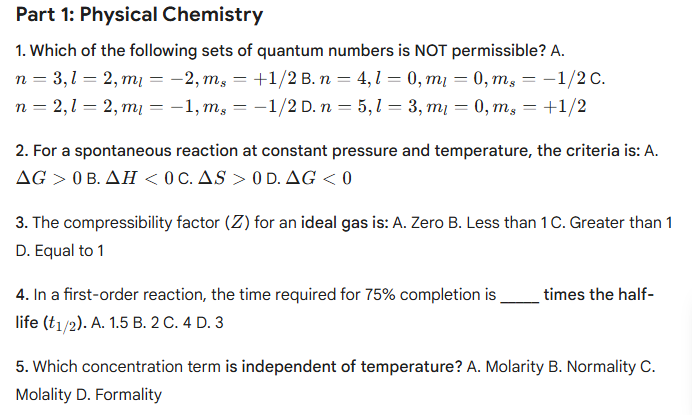
Part 1: Physical Chemistry Solutions
- C (If $n=2$, $l$ can only be 0 or 1. $l$ cannot equal $n$).
- D ($\Delta G < 0$ is the condition for spontaneity).
- D (For ideal gas, $PV = nRT$, so $Z = PV/nRT = 1$).
- B (For 1st order: $t_{75\%} = 2 \times t_{50\%}$. It takes two half-lives to reach 75%).
- C (Molality depends on mass of solvent, which is temperature independent. Molarity depends on volume).
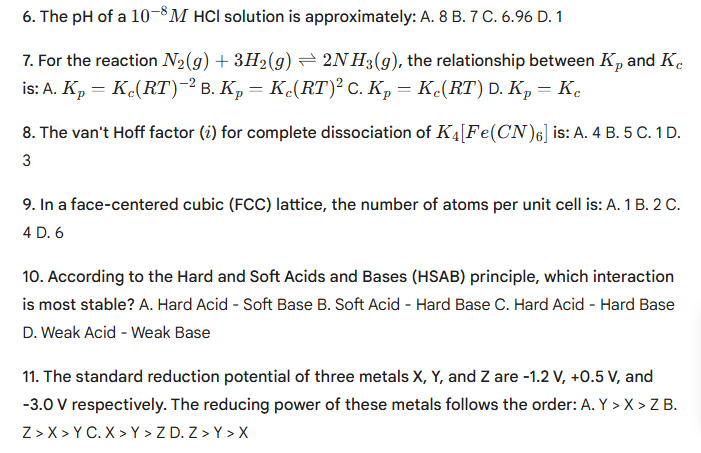
- C (Contribution of $H^+$ from water ($10^{-7}$) must be added. Total $[H^+] \approx 1.1 \times 10^{-7}$, so pH is slightly less than 7).
- A ($K_p = K_c(RT)^{\Delta n}$. Here $\Delta n = 2 – (1+3) = -2$).
- B ($K_4[Fe(CN)_6] \to 4K^+ + [Fe(CN)_6]^{4-}$. Total ions = 5).
- C (Corners: $8 \times 1/8 = 1$; Faces: $6 \times 1/2 = 3$; Total = 4).
- C (Stable complexes form between Hard-Hard or Soft-Soft interactions).
- B (More negative reduction potential = Stronger reducing agent. Z(-3.0) > X(-1.2) > Y(+0.5)).
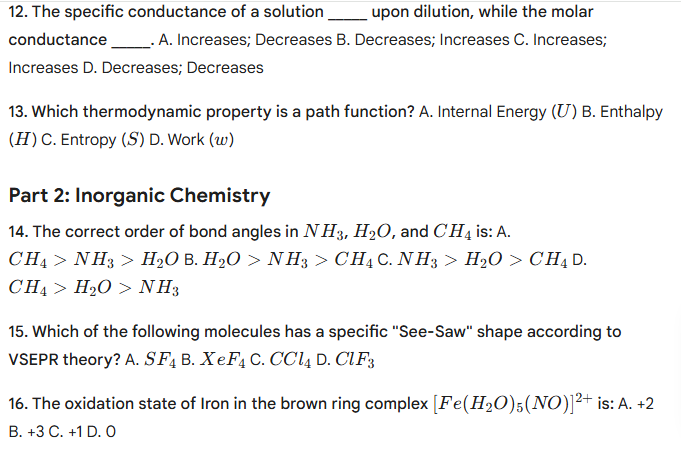
- B (Specific conductance decreases (fewer ions per unit vol), but Molar conductance increases (ions move freer) on dilution).
- D (Work and Heat are path functions; U, H, S are state functions).
Part 2: Inorganic Chemistry Solutions
- A ($CH_4$ ($109.5^\circ$) > $NH_3$ ($107^\circ$) > $H_2O$ ($104.5^\circ$) due to lone pair repulsion).
- A ($SF_4$ has 4 bond pairs and 1 lone pair = See-Saw shape).
- C (In the brown ring complex, NO is $+1$ and Iron is $+1$).
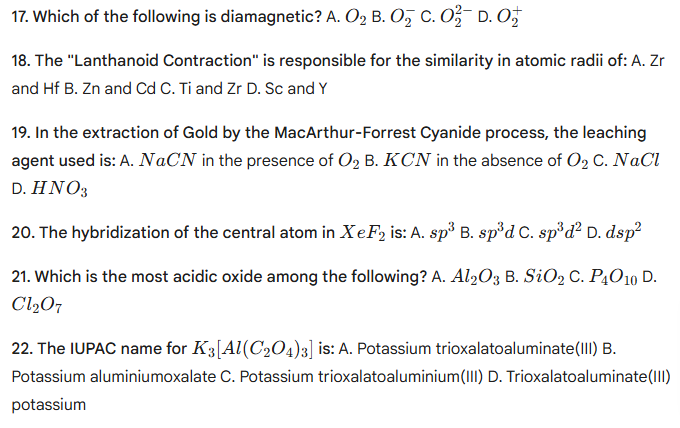
- C ($O_2^{2-}$ (Peroxide ion) has no unpaired electrons in antibonding orbitals).
- A (Due to poor shielding of f-electrons, Hf has similar size to Zr).
- A (Formation of soluble complex $[Au(CN)_2]^-$ requires oxygen).
- B (Xe has 8 valence $e^-$. 2 bonds + 3 lone pairs = 5 steric number = $sp^3d$).
- D (Non-metal oxides are acidic. Higher oxidation state ($+7$ for Cl) increases acidity).
- A (Potassium trioxalatoaluminate(III)).
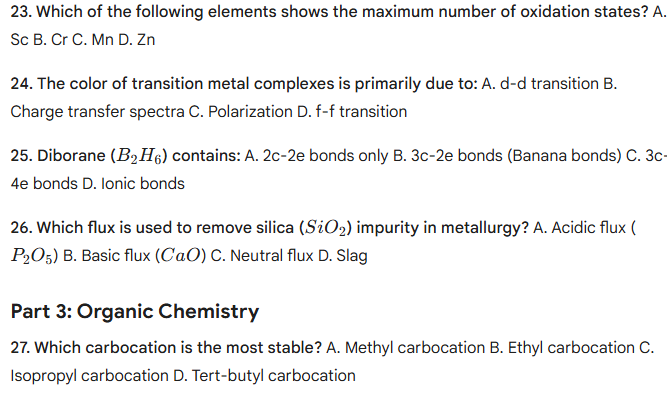
- C (Manganese shows states from +2 to +7).
- A (Transitions of electrons between split d-orbitals absorb visible light).
- B (Three-center two-electron bonds bridge the Borons).
- B (Silica is an acidic impurity, so a basic flux like CaO is used).
Part 3: Organic Chemistry Solutions
- D (Tertiary carbocations are stabilized by inductive effect and hyperconjugation of 3 alkyl groups).
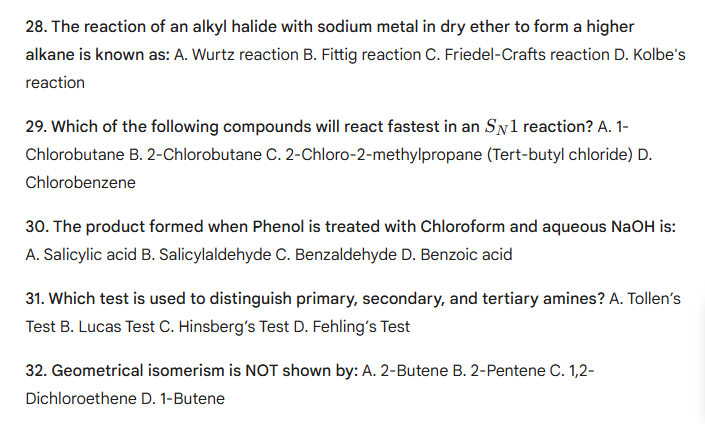
- A (Wurtz reaction doubles the carbon chain).
- C ($S_N1$ proceeds via carbocation intermediate. Tert-butyl cation is most stable).
- B (Reimer-Tiemann reaction produces Salicylaldehyde).
- C (Hinsberg’s reagent (Benzenesulfonyl chloride) reacts differently with $1^\circ$, $2^\circ$, $3^\circ$ amines).
- D (1-Butene has two identical Hydrogens on one carbon ($CH_2=$), so no geometrical isomerism).
- A (High temp favors elimination to alkene; low temp favors ether).
- B (Nucleophile ($OH^-$) attacks the carbonyl carbon).
- D (Sucrose involves glycosidic linkage between reducing ends of glucose and fructose).
- B (2-chloro-1,3-butadiene).
- A (Nitro group (-M, -I) increases acidity; Methyl group (+I) decreases acidity. p-Nitro > Phenol > p-Cresol).
- A ($LiAlH_4$ is a strong reducing agent capable of reducing acids to alcohols. $NaBH_4$ generally cannot reduce acids).
- B (Iodoform test is positive for methyl ketones or methyl carbinols ($CH_3-CH(OH)-$). Ethanol has this group).
- C (Friedel-Crafts Alkylation is an Electrophilic Substitution reaction).
Psychology, Pedagogy & Educational Commissions Question Bank
Answer Key & Explanations
- D (Formal Operational Stage: Emerges around age 12, characterized by abstract thought).
- B (Vygotsky emphasized the gap between what a learner can do alone vs. with help).
- A (Alfred Binet introduced the concept to distinguish ‘bright’ from ‘dull’ children).
- B (J.B. Watson established Behaviorism).
- C (Before conditioning, the bell has no effect, so it is Neutral. After conditioning, it becomes the Conditioned Stimulus).
- A (Dyslexia is a reading disorder).
- C (Howard Gardner proposed 8 [now 9] types of intelligence).
- C (Creating is the highest order thinking skill in the revised taxonomy).
- B (It is a teacher training technique).
- B (Formative assessment happens during instruction).
- C (Pragmatism/John Dewey’s philosophy; developed by Kilpatrick).
- A (Rote memorization is a trait of teacher-centered/traditional methods).
- A (H.E. Armstrong; involves learning by discovery).
- C (Kothari Commission recommended a common school system and 10+2+3 structure).
- B (Mudaliar Commission focused specifically on Secondary Education).
- A (5+3+3+4: Foundational, Preparatory, Middle, Secondary).
- B (To provide minimum essential facilities in primary schools).
- C (Enacted in 2009, came into force in April 2010).
- B (Sam Pitroda).
- A (Ishwar Bhai Patel Committee reviewed the 10-year school curriculum and emphasized SUPW).
Answer Key & Solutions
Part 1: Indian GK
- C (Dr. B.R. Ambedkar)
- B (Godavari is the second longest river in India after Ganga).
- A (1757; between Siraj-ud-Daulah and Robert Clive).
- B (Kerala; identified by elaborate makeup/costumes).
- C (Venus; brightest planet).
- A (Mundaka Upanishad).
- C (Swami Dayanand Saraswati in 1875).
- B (Hirakud Dam on Mahanadi river is the longest; Tehri is highest).
- C (Odisha; Tropic of Cancer passes through 8 states: Gujarat, Rajasthan, MP, Chhattisgarh, Jharkhand, WB, Tripura, Mizoram).
- B (Launched in April 1973).
- A (Fundamental Duties).
- B (Lord Mountbatten; C. Rajagopalachari was the first Indian Governor-General).
- C (Mumbai).
- C (Carbon Dioxide).
- B (Ashoka; led him to embrace Buddhism).
- B (Manipur; on Loktak Lake).
- C (Jawaharlal Nehru; written during his imprisonment).
- B (Immediately follows Question Hour, usually at 12 PM).
- C (Black Soil/Regur).
- A (Guru Shikhar in Mount Abu).
Part 2: HP GK
- C (Ravi).
- B (Lahaul and Spiti; known as the ‘Ajanta of the Himalayas’).
- C (Dr. Y.S. Parmar).
- C (Kullu).
- B (Dulchi Pass).
- C (Jan 25, 1971; became the 18th state).
- A (Chamba).
- B (Chandra Tal; Suraj Tal is Lake of the Sun).
- B (12 districts).
- A (Shimla/Kullu/Sirmaur regions).
Part 3: English Grammar
- C (Addicted to).
- B (Pessimistic).
- C (“One of the boys” takes a singular verb: is missing).
- B (Frank/Honest).
- C (Subjunctive mood for imaginary situations uses “were”).
- B (Accommodation – double c, double m).
- B (To initiate conversation in an awkward silence).
- B (Present Continuous Passive: is/am/are + being + V3).
- B (An apple).
- B (Atheist).
Part 4: Hindi Grammar
- D (पयोधर का अर्थ बादल है)।
- A (विद्या + आलय = विद्यालय; दीर्घ स्वर संधि)।
- B (घोड़ा)।
- C (अव्ययीभाव; शक्ति के अनुसार)।
- B (डराना या गुस्से से देखना)।
- B (आशीर्वाद)।
- A (पतन)।
- C (सर्वज्ञ)।
- B (अनल = आग, अनिल = हवा)।
- A (14 सितंबर)।
Part 5: Reasoning
- C (Pattern is $n^2 + 1$: $1^2+1=2$, $2^2+1=5$, $3^2+1=10$, $4^2+1=17$, $5^2+1=26$, $6^2+1=37$).
- A (Alphabet positions: C=3, A=1, T=20).
- C (“Only daughter of my mother” is the speaker herself. So the speaker is the man’s mother).
- D (Cube is 3D; others are 2D shapes).
- A (If all dogs are birds, and some cats are dogs, the intersection of cats and dogs must also be birds).
Part 6: Current Affairs
- B (António Guterres).
- C (India).
- B (Iran; Human rights activist).
- B (Aditya-L1).
- C (Australia defeated India in the final).